Yuen Kay-San Wing Chun Kuen 阮奇山詠春拳
=
Sum Nung Wing Chun
=
Guangzhou Wing Chun
A (forgotten) hero
There was a time in China when people used to say that the rich
learned kung fu, while the poor studied literature. People used to
say—-and still do-—that some Wing Chun masters were better than
others, just as one branch of Wing Chun was considered superior to
another.
Popular opinion is not always fair: it sometimes elevates one person
to the status of a hero for reasons that are not entirely justified,
while overlooking the true hero. In the world of Gung Fu, a truly
exceptional fighter has suffered this fate, being often forgotten.
Yet he remains very much alive in the hearts of true specialists,
practitioners of his lineage, and devoted enthusiasts.
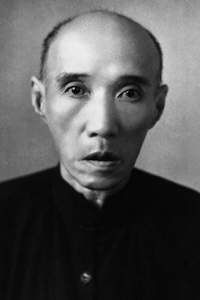
Great Grand Master Yuen Kay-San
Yuen Kay San not only learned Wing Chun Kuen, but became deeply
fascinated by the system, driven by a desire to understand its
deeper principles. Early Wing Chun featured a wide variety of
movements—more than 108, a number that is often cited. Yuen Kay-san
first learned Wing Chun from Fung Siu-Ching; drawing on his
extensive education—he was what we would today call a lawyer—he
systematized his master’s kung fu, thereby modifying it and very
likely improving it, while retaining only the most practical
movements. He was among the first masters to document his system
precisely in writing. Yuen Kay-san was a scholar and historian of
Wing Chun.
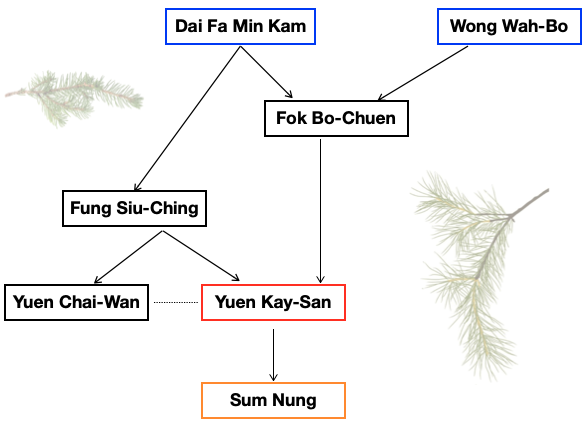
In southern China, particularly in Guangdong, including Foshan,
challenges between martial artists are particularly well documented
from the late Qing dynasty through the first decades of the Republic
of China. Clashes between martial arts schools and formal challenges
were a genuine part of the martial culture of the region and could
result in serious injuries or even death. These confrontations
generally arose from challenges between schools and were intended to
establish the reputation or superiority of a particular style,
sometimes taking the form of formal duels. When a challenge was
issued to Wing Chun, Yuen Kay-San was recognized by the Wing Chun
community in Guangdong as the fighter capable of accepting it and
representing the art. Yuen Kay-San is said to have fought in as many
as 1,000 duels during his lifetime.
His student
Yuen Kay-San taught very few students. Wong Jing (Wong Ching)
studied under him, but is generally distinguished from Sum Nung, who
is regarded as Yuen’s principal—and only—formal direct disciple.
Yuen Kay-San passed his system on primarily to Sum Nung, who
subsequently devoted his life to preserving and transmitting his
teachings. Sum Nung had only a few direct disciples, although no
definitive number is known-—approximately ten or eleven are
identified by name (Sum Jee, Cheung Mo-Gan (Cheung Chut), Kwok
Jin-Fen, Leung Dai-Chiu, Dong Chuen-Kam, Ngo Lui-Kay, Kwok Wan-Ping,
Lee Chi-Yiu, Wong Wah (Tom Wong), Teddy Wong, Felix Leong).
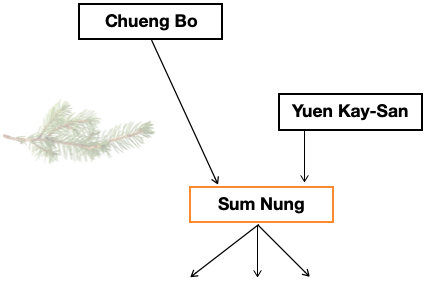
Biographical information
https://www.yunhoiwingchun.com.au/yuen-kay-san/
T H I S P
A G E I S U N D E
R C O N S T R U C T I O N
o O
° O o